Ron on Science-Faith debates — Upshaw 2025 12 03
Intro…
Creationism purports to be scientific, yet its advocates commonly fail to publish in scientific journals or present their “research” at scientific conferences. That is, they typically fail to be open to critique by experts in the field.
Creationism may be of two types, YEC or OEC (either committed to a young-earth six literal day creation event or committed to a “gap” theory where they accepted a much older form of the earth). Both types adopt a literalist interpretation of Genesis 1 and 2, which then provides boundaries within which the movement approaches scientific investigation and a critique of such. The pursuit of Truth is thus delimited by a biblical interpretation which restricts a free and open pursuit of evidence from Nature wherever it might lead.
My own view (reflecting a life of Evangelical church attendance, PhD in academia, and a year of seminary) is that evidence arising from our interpretations of God’s created order (Nature) and from scripture must fall into some kind of agreement since the Reality we believe to exist is singular in its existence. (See Related Resources below.)
Christian scientists, more generally, are not inclined to define themselves as “creationists” (due to the prevailing definitions above), choosing rather to identify, when appropriate, simply as Christian scientists who chose to follow the rigorous procedures of doing science. But let’s clarify that by “science” I am referring here to the practices of disciplined science and not the philosophical ideology known as “scientism” which differs from it in profound ways.
My response to a posting on Evolution and Creationism Open Debates.
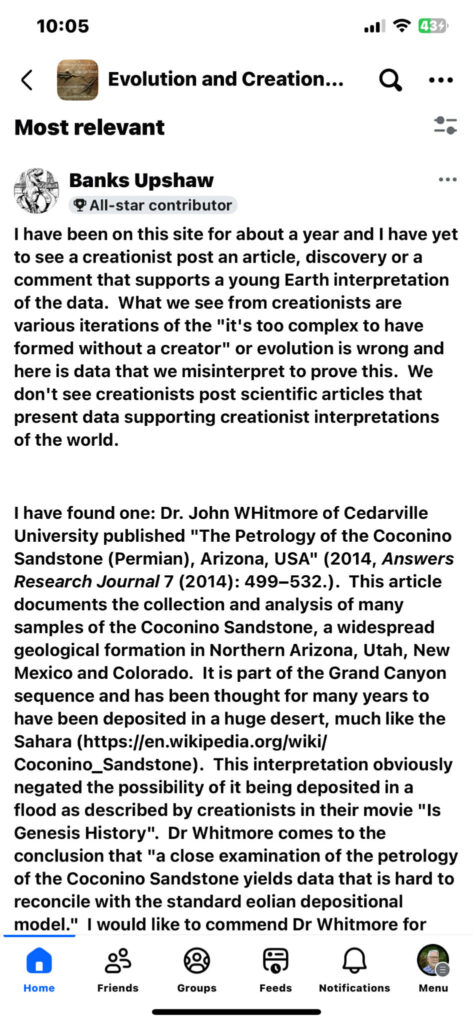 I respond to Banks Upshaw’s posting (below). He is a critic of Creationism, but expresses his appreciation for one such creationist who does published his perspective and findings in the more established scientific manner.
Ron Richmond writes:
A welcomed comment and perspective. There are many Christian scientists who are motivated not by defending and promoting an ideology, or a particular biblical interpretation, but inspired by wonder at the complexity of Life and Nature generally.
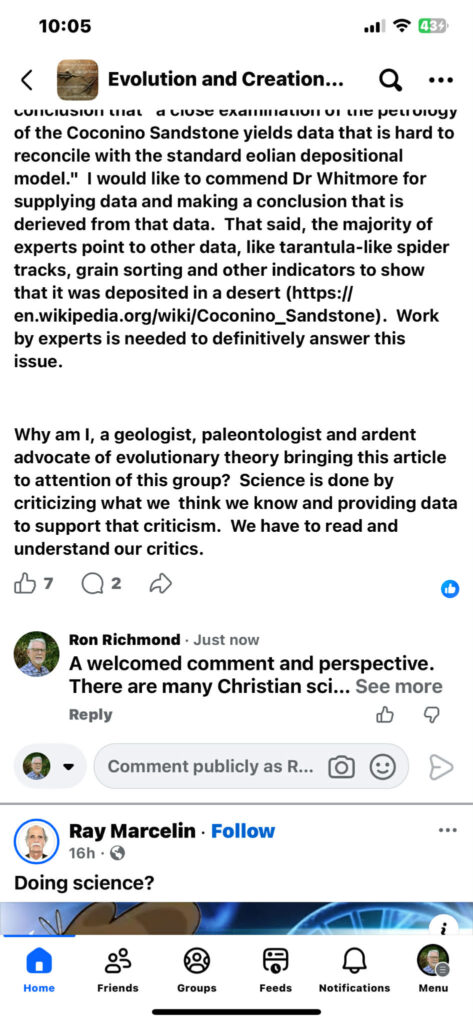 The original posting to which I responded:
I have found one: Dr. John WHitmore of Cedarville University published “The Petrology of the Coconino Sandstone (Permian), Arizona, USA” (2014, Answers Research Journal 7 (2014): 499–532.). This article documents the collection and analysis of many samples of the Coconino Sandstone, a widespread geological formation in Northern Arizona, Utah, New Mexico and Colorado. It is part of the Grand Canyon sequence and has been thought for many years to have been deposited in a huge desert, much like the Sahara (https://en.wikipedia.org/wiki/Coconino_Sandstone).
Why am I, a geologist, paleontologist and ardent advocate of evolutionary theory bringing this article to attention of this group? Science is done by criticizing what we think we know and providing data to support that criticism. We have to read and understand our critics.
This page by: Ron Richmond
First published: 2025/12/10
Latest revision: 2026/01/18