Book: England Before and After Wesley by Bready (reprint by Tymchak/Ninan)
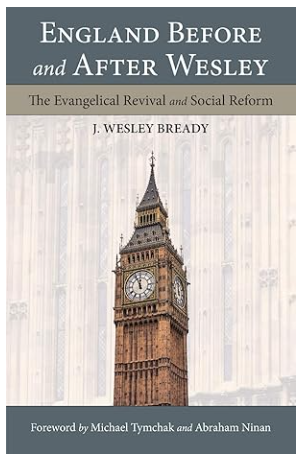 J Wesley Bready, England Before and After Wesley: The Evangelical Revival and Social Reform (1938), has been republished by Mchael Tymchak and Abraham Ninan (2021) with a Foreword.
My first awareness of the Bready book came from a historical sketch of the work of the Salvation Army provided by Maj Karen Hoeft. She was describing the conditions of the mid-eighteenth century, the times that gave rise not only to John Wesley but also William Booth and other evangelical leaders. I was doubly delighted to find that a former colleague, Dr Michael Tymchak, had also found this historical treasure and had chosen to get it reprinted.
Some excerpts from the Foreword (by Tymchak and Ninan) follow:
Ideas have consequences and, as Bready so eloquently argues, the nature and character of these ideas will be manifested in their social expression. In our view even a casual reading of this book will convince readers that in the eighteenth and nineteenth centuries, at least, evangelical religion–as found in the life and teaching of John Wesley–had profound consequences that were anything but an opiate of the people (contra the teachings of Karl Marx). Instead, “vital religion” proved itself to be powerfully transformative, not only in the personal lives of its converts, but also in the deepest fibre of their social and political lives.
Wesley Bready’s careful documentation of the profound social and political influence of John Wesley’s preaching and teaching will, for many readers today, prove to be a convincing demonstration of the transformative power of the gospel of Jesus Christ. The power and scope of this evangelical Christian influence was extraordinary: from education to health care; from the needs of the poor and orphans, to prison reform and the founding of democratic institutions; from the promotion of good reading to an end to cruelty to animals (and founding of the RSPCA). All of these, and more, are the hallmarks and outward manifestations of a vital Christian faith.
…
In our view a fair-minded assessment of the impact of John Wesley’s life also has much to say about the contested space of Christian faith in society today. We acknowledge that its critics would prefer to understand and portray faith in a very negative light, for example, as aiding and abetting colonialism, or promoting the oppressive hierarchies of the status quo and its elites. Bready’s book runs completely contrary to this analysis. Instead, he forcefully argues that the influence of “vital faith” was consistently ameliorative and emancipatory.
…
[W]e see the contagion of Wesley’s influence on members of the Church of England in the century that follows, evidenced by reformers like William Wilberforce and his battle to end slavery, or the Earl of Shaftesbury’s valiant efforts to bring educational opportunities to the poor (e.g., ragged schools), as well as his political activities expended to emancipate the working people of industrial England (e.g., in the matter of child labour).
Some readers will be a little surprised (even shocked) by the scope of the inspired movements that are cited: consider, for example, the thoroughly “converted” Keir Hardie and his role in the founding of the Labour Party in Britain: “His conversion… unified his every faculty, intensified his humanitarian zeal, and made him a dynamic leader of men. Henceforth he was to be an apostle, a crusader, an evangelist proclaiming a Message; and that message centered in the Fatherhood of God, the Brotherhood of man and the things appertaining to the Kingdom of Christ on earth.”
The book is available from Amazon at CAD 37.99.
https://www.amazon.ca/England-Before-After-Wesley-Evangelical/dp/1573835943/
Tymchak and Ninan also makes reference to current academics in India that strongly credit the contribution of Western culture and Christian faith during colonial times. Specifically, he notes the the contributions of Vishal Manglwadi in his book, The Book That made Your World: How the Bible Created the Soul of Western Civilization (2011). (An interview with Manglwadi highlights many of his insights and is available here.)
With permission of the authors and publisher, the full Foreword by Tymchak and Ninan of the latest edition of the book by Bready can be accessed here:
Tymchak and Ninan England Before & After Wesley Fwd.pdf
This page by: Ron Richmond
First published: 2024/05/07
Latest revision: 2024/10/18