Reflecting on our new Governor General’s installation speech
Intro…
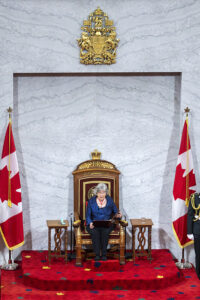 How might we view the appointment of Her Excellency, the Right Honourable Louise Arbour?
Specifically, how does Louise Arbour’s installation speech resonate with a biblical worldview? In what areas might we find meaningful points of agreement, and where might thoughtful questions or concerns arise?
A missional church perspective seeks to affirm values, insights, and practices that align with the teachings of Christ wherever they are found. Like the Apostle Paul, our discernment involves articulation of the reasons for our faith—reasons that transcend prevailing secular ideologies and are rooted distinctly in the gospel itself.
In her address, our new Governor General reflected on the formative influence of family, church, and education. She spoke also of her lifelong commitment to learning and of the opportunities this provided for service in significant national and international roles.
As parents, educators, and leaders, in what ways might her story affirm our own understanding of nurturing, discipleship, and the development of individuals for lives of meaningful service?
The Installation Address by Her Excellency
Installation Speech from Her Excellency the Right Honourable Louise Arbour, 31st Governor General of Canada | The Governor General of Canada
A printable copy is downloaded and formatted here for personal and small group study.
.
Reflections
Louise Arbour chose to draw our attention to these point, among others:
- The diversity of Canada, beginning with Indigenous peoples, their cultural perspectives, and their distinct understanding of history.
- The roots of her own identity and values—as a Catholic, Francophone, white woman—and the ways her perspectives have broadened through what she described as the “richness of the connections made” with others.
- The influence of perspective and underlying assumptions, illustrated by her encounter with young Chinese tourists in New York City who surprisingly perceived the city as “so old.”
- The rule of law and its purpose, which she described as existing “not to restrain but to construct a greater freedom for all.”
- Her reflections on values, including the conviction that “we do not mistake humility for weakness, nor do we measure a person’s worth by the thickness of their wallet.”
These are only a few examples from a speech rich with themes worthy of thoughtful reflection. Nearly every paragraph could generate thoughtful discussion and debate.
I suspect that Louise Arbour may find it difficult to remain merely a passive ceremonial figure. Whether publicly or behind the scenes, she is likely to continue advocating for the values she holds dear. Should Christians respond with fear? Or should we instead approach her words and actions with discernment, supporting what is commendable while thoughtfully evaluating areas of concern?
Certainly, she was appointed by a Liberal government. But should that fact alone determine how we view her? Should she be accepted or dismissed primarily through a political lens? A more constructive approach may be to engage her ideas on their own merits, weighing the strengths and weaknesses of each.
In a political climate often marked by polarization and division, Arbour might be viewed here as seeking a different path? Consider the following expressed points:
- Promoting both Canada’s national identity while also recognizing “our influence in the world,” seeking a balance between nationalism and international engagement.
- Acknowledging both the comforts and limitations of homogeneity, and reflecting on the attraction—and potential dangers—of ideological thinking.
- Suggesting that our security ultimately depends “on the trust we place in each other,” an idea that encourages us to engage individuals thoughtfully rather than reducing people to group identities or labels.
- Valuing traditions of respect and honour, while also affirming inclusion rooted in human dignity.
Toward the conclusion of her speech, she expressed concern about the “blurring” of several conceptual distinctions:
- Knowledge and belief
- Truth and falsehood
- Facts and assumptions
These she might view as foundational clarifications needed for quality public dialogue on challenges facing our western culture.
As Evangelical Christians, are we prepared to engage thoughtfully and respectfully on such matters? Are we equipped to contribute to conversations about truth, knowledge, human dignity, and the common good as part of our Christian witness? Perhaps these are matters of greater relevance than many of us realize.
.
Choosing to share viewpoins
Might there be small groups within our churches that might choose to engage in analysis? Would some care to share their views within our network? Feel free to contact me.
This page by: Ron Richmond
First published: 2026/06/11